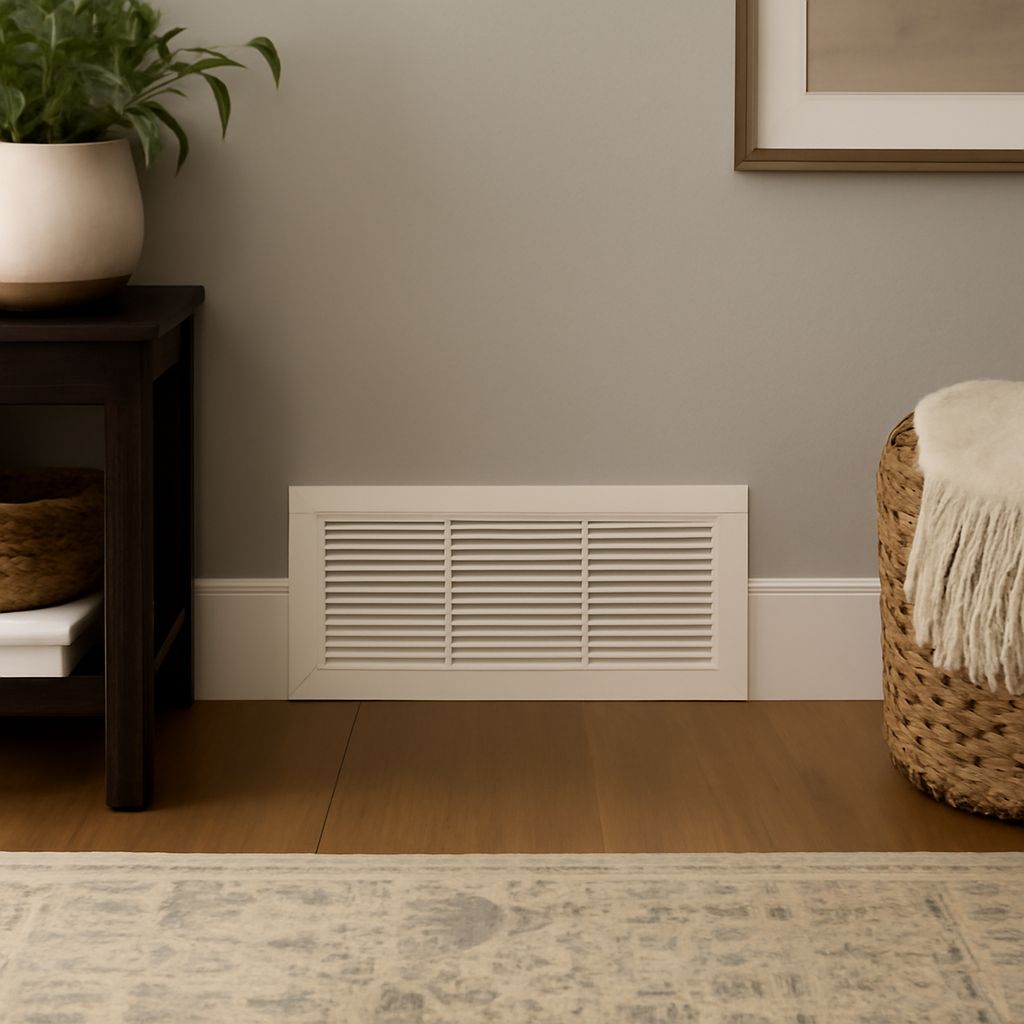
Measure the duct opening before shopping for a register at the baseboard. Covers for baseboard vents are sold in several shapes, and the visible face can be larger than the hole it serves. You need a fit that leaves the air a clear path into or out of the room.
Identify what is behind the cover
Run the heating or cooling system’s fan and hold a light tissue near the opening. If air pushes it away, you have a supply outlet; if it pulls the tissue toward the opening, you have a return. Keep the tissue outside the grille. A supply register often has a damper to adjust flow; a return grille commonly has fixed openings. Choose a replacement intended for the job. Registers at the baseboard can serve either purpose, so check the airflow first.
A baseboard register is part of a forced-air duct system. A baseboard air register moves air that was heated or cooled elsewhere. A similarly shaped electric baseboard heater contains an electrical heating element, while a hydronic baseboard heater has a hot-water pipe and fins. Neither is simply a duct opening. Heater enclosures need parts made for that particular heater; do not substitute an air register or remove an electrical cover while the circuit is energized.
Some listings call duct outlets baseboard heat registers because they deliver warm air. Registers for baseboard heat may also carry cooled air when the same central system runs in summer. Identify the equipment and the opening before trusting a product name.
Baseboard vent covers: Compare shapes and mounting
A sloped face meets the wall and floor; a rectangular one may mount just above the floor. A raised housing can bridge a floor opening and the baseboard. Baseboard vent covers must fit the duct location as well as the room. The right shape depends on where the duct ends, how the trim meets the floor, and the clearance in front of it.
Look at the back as well as the front. Some baseboard registers have a projecting collar that fits inside a duct; others cover an opening with a surface-mounted frame. Compare the manufacturer’s dimensions and mounting method with the opening you have. Screw holes, trim thickness, and an uneven floor can all affect whether the frame sits securely.
Vent covers at the baseboard also need a material suited to their location. Steel, wood, and plastic have different finishes and durability; check the intended location and load rating. A cover for a baseboard vent should provide enough open area for the air it must pass.
Measure the opening, not just the face
Turn off the fan and remove the cover if safe. Measure and record in inches:
- Measure the duct opening’s width and height, or width and depth if the opening is in the floor. Measure the clear opening, not the outside edge of the old face.
- Measure the old cover’s overall width, height, and projection into the room. Check that the new face will cover the unfinished edges without colliding with trim or flooring.
- Measure the depth available for any collar or damper behind the face. Note obstructions and the position of screw holes.
- Record the distance to doors, furniture, and nearby trim so the housing and its airflow have room.
A register mounted at the baseboard must match the duct rather than the old decorative face. For example, an opening measuring 12 by 2 inches calls for a product whose specified opening size matches those measurements. Its outside face will usually be larger. Covers for vents at the baseboard can conceal a smaller opening. Manufacturers label dimensions differently, so check the drawing: a nominal size, the actual collar dimensions, and the outside dimensions are separate facts.
Have damaged ductwork or unidentified material assessed before disturbing it. Photograph an unusual opening for the supplier.
Match direction and airflow
A baseboard register on a supply duct should send air into the room rather than directly into a curtain or a piece of furniture. Check the louver direction in the installed orientation: a face that looks suitable on a shelf may point air toward the wall when mounted. Baseboard supply registers with adjustable vanes can help aim the stream; leave the damper open while establishing how the room performs.
The size of the hole is only part of the story. Louvers, screens, and a partially closed damper all occupy space in the air path. Two baseboard vent cover designs with the same outside dimensions can have different resistance to flow. The U.S. Department of Energy’s guidance on duct terminals connects proper grille sizing and placement with airflow, drafts, and noise.
Compare a candidate’s published airflow and pressure-drop data at the required cubic feet per minute (CFM), if available. If the required flow or the product data is unknown, ask an HVAC contractor to assess the outlet and select a suitable replacement. Do not reduce the duct opening or add dense decorative screening simply to make a smaller face fit.
Registers installed along the baseboard need clear space around them. For a return, choose a grille rated for return air and keep its passage clear. Closing or blocking a return can interfere with the system’s air path. For supply and return alike, leave furniture and rugs clear of the face, then run the fan and listen for a new whistle or rattle. Have a professional check persistent noise or weaker flow.
Before you buy
Bring the opening width and height or depth, the old face’s outside dimensions, available collar depth, and a photo. Confirm supply versus return, mounting and screw locations, louver direction, clearance around the cover, and the product’s airflow suitability. A register fitted at the baseboard should sit securely without pinching the air path. With those checks in hand, you can choose a face that fits the room and lets the duct do its job.