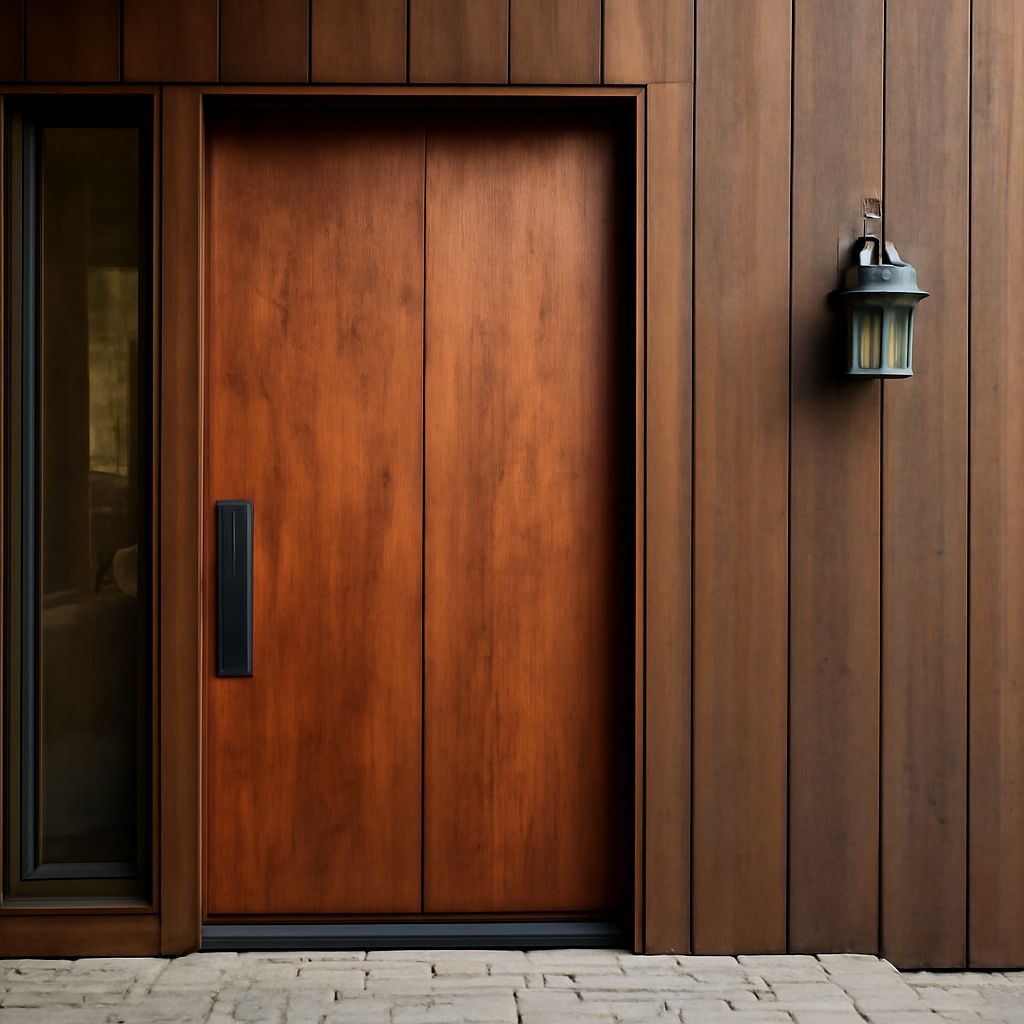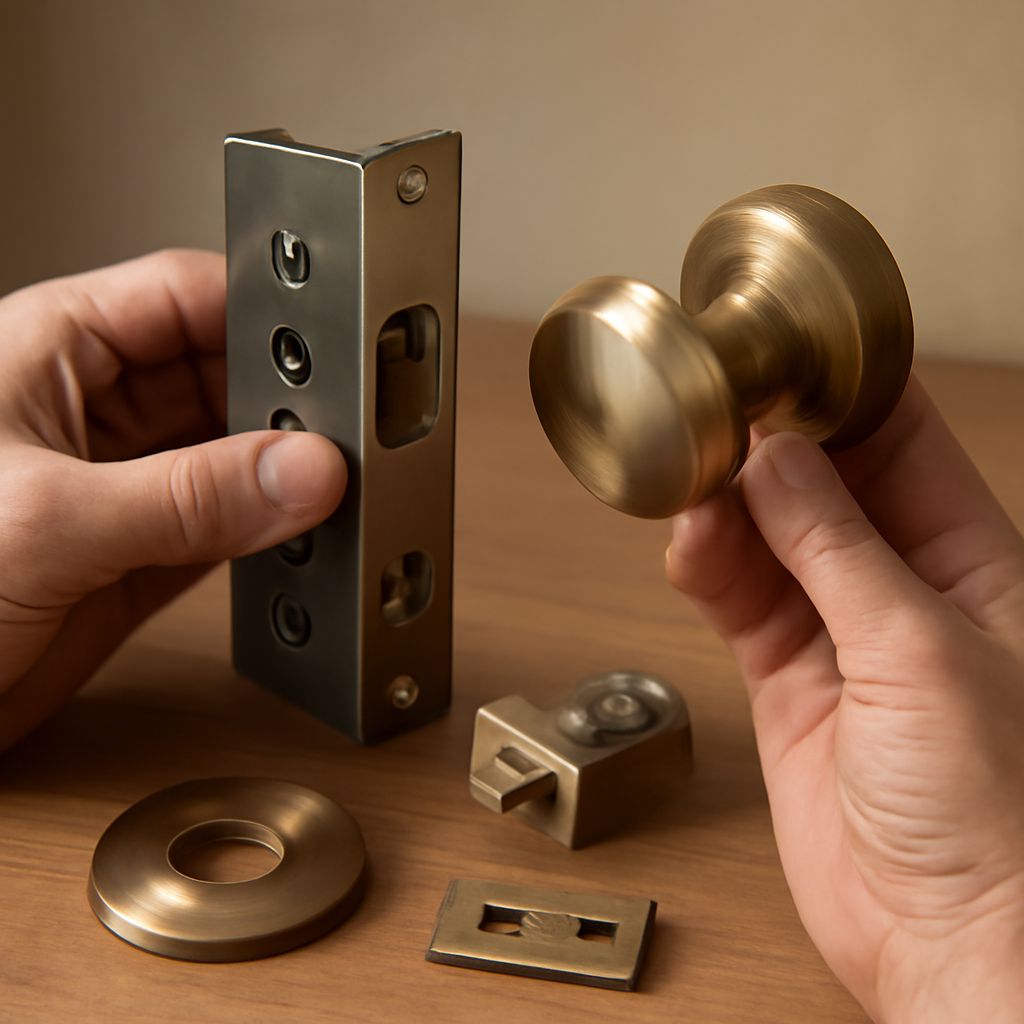
Start at the edge of the door: the spring-loaded latch is the piece that enters the frame when the door closes. Trace it back to the knob, its trim, and the fasteners to identify the components of a door knob before shopping. The parts in a door handle assembly follow the same basic path when the handle is a lever.
A few measurements taken now can save a second trip to the store. The parts of a door knob work together as a set, and a replacement must suit both the door preparation and the function you need.
Parts of a door handle: a labeled tour
Imagine looking from the room side of a closed door toward the frame. This list follows the assembly from the grip through the door to the jamb:
- Knob or lever: The grip you turn or press. It operates the latch through the mechanism inside the door. A knob rotates; a lever generally moves downward. Either can be supplied as part of a passage, privacy, or keyed set.
- Rose or escutcheon: The trim around the grip on the door face. It covers the mounting area and gives the assembly a finished edge. Some sets use a long plate instead of a round rose.
- Spindle and chassis: Among the door knob parts, the spindle transfers movement from the grip into the latch mechanism; the chassis supports the working mechanism and mounting connections. Designs differ, so a loose knob does not automatically mean the spindle needs replacement.
- Latch and latch bolt: This door knob component sits in the edge of the door. Its spring-loaded bolt projects into the strike opening and retracts when the grip operates. A sloped bolt helps the door close against the frame.
- Faceplate: This door knob part at the door edge surrounds and secures the latch. It may have rounded or square corners; some installations use a round drive-in collar instead.
- Strike plate: Fixed to the jamb, it surrounds the opening that receives the latch bolt. Its shape and screw positions matter when reusing an existing frame preparation.
- Mounting screws: These door knob components hold the two sides of the assembly together or secure the latch and strike. Use the fasteners supplied or specified for the chosen set.
- Cylinder or privacy control: In door knob assemblies, this part varies by function: a keyed set has a cylinder for a key; a privacy set commonly has an interior button or turn. Passage sets have no locking control, and dummy trim is non-turning decoration or a pull.
The parts of a door knob are easier to discuss when you distinguish the latch on the door from the strike on the frame. Schlage’s hardware glossary illustrates these terms and explains the related door preparation.
Match the function to the room
A hall or closet usually calls for passage hardware: the latch holds the door closed, but there is no lock. A bedroom or bathroom often calls for privacy hardware, while an exterior entry may call for a keyed set. A dummy knob can serve as a pull on a door that uses a separate catch; it has no working latch of its own.
The parts of a door handle may look alike across these functions, yet the internal mechanisms differ. Compare the handle parts for the door by function before matching the finish. Door handle components must suit that function. For an exterior door, account for any separate deadbolt and retain the level of security the opening requires. If a lock is damaged or the door will not secure properly, a locksmith can assess the complete assembly.
Read the signs of wear
Worn knob parts can produce distinct symptoms. A sagging grip, a latch that fails to retract smoothly, or a door that will not stay closed points to different areas of the assembly. With the door open, operate the grip and observe whether the latch moves freely. Then close the door gently and check whether the bolt meets the strike opening. Binding at the jamb can reflect door alignment rather than a failed latch.
Check visible mounting screws for looseness and look for cracked trim or worn surfaces. Do not force a stiff mechanism: identify its model and follow the manufacturer’s care instructions, or call a professional. The working components of the knob are often sold together; if an individual component is damaged, confirm that the manufacturer offers the correct replacement for that model.
Measure the opening before ordering
The parts of a door knob must fit the holes and thickness already present. Use a tape measure and record these dimensions:
- Backset: Measure from the door edge to the center of the large hole on the door face. Common residential sizes are 2 3/8 and 2 3/4 inches. Some latches adjust to both, but check the chosen model.
- Door thickness: Measure across the edge. For example, Schlage’s J Series Byron passage knob lists a 1 3/8- to 1 3/4-inch door range and an adjustable latch for both common backsets. Other products can have different limits.
- Bore openings: Measure the diameter of the face hole and the latch hole in the edge. Compare both with the product template; Schlage’s door preparation guide describes the measurements.
- Edge and jamb preparation: Note faceplate shape and dimensions, strike shape, and screw locations. A matching finish cannot compensate for a plate that does not fit its recess.
A diagram of door handle parts names the grip, spindle, latch, and strike; the measurements tell you whether a particular set will fit. Different manufacturers may use different door handle component names for the same function. A supplier’s chart of door hardware parts names each component, but a replacement part also needs the correct model and connection. Compare the parts in the door knob set with the manufacturer’s diagram before ordering a single piece: similar-looking spindles and mounting points need not interchange between brands or product lines.
Finally, compare your recorded backset, door thickness, bore diameters, and plate dimensions with the replacement’s specifications. That short comparison costs less time than buying the wrong assembly twice.