Electrical Code for Outlets: Spacing, Count, and Room Requirements
The electrical code for outlets defines exactly where receptacles must appear in every room of a home — not as a suggestion, but as a minimum standard enforced at inspection. How many outlets per room is a question with specific code answers that most homeowners don’t know until they’re in the middle of a renovation. Knowing how far apart should outlets be in living spaces prevents failed inspections and the cost of adding boxes after drywall is already up. The code for electrical outlets is found primarily in Article 210 of the National Electrical Code (NEC), with specific rules for different room types. Code for electrical outlets spacing varies between living areas, kitchens, bathrooms, and outdoor locations — each has distinct requirements.
General Living Space Outlet Spacing Requirements
The 6-Foot Rule
In all habitable rooms — bedrooms, living rooms, dining rooms, and dens — the NEC requires outlets spaced so that no point along any wall is more than 6 feet from a receptacle outlet. This translates practically to: outlets must be placed within 6 feet of any doorway and at maximum 12-foot intervals along open wall runs. The logic is that any standard appliance cord (approximately 6 feet) should reach an outlet without an extension cord when plugged in from anywhere along the wall.
This 6-foot rule applies to wall segments 2 feet wide or wider. Short wall sections, fixed glass panels, and sliding door spaces don’t require outlets. But any usable wall space of 2 feet or more needs to be counted in your outlet placement plan.
Bedroom Outlet Placement
Bedrooms follow the same 6-foot general rule. The code for electrical outlet spacing in bedrooms also requires AFCI (arc-fault circuit interrupter) protection on all bedroom circuits in new construction. AFCI breakers detect the kind of arcing that occurs in damaged wiring and turn off the circuit before it causes a fire inside a wall — a protection that standard GFCI breakers don’t provide.
Kitchen Outlet Code Requirements
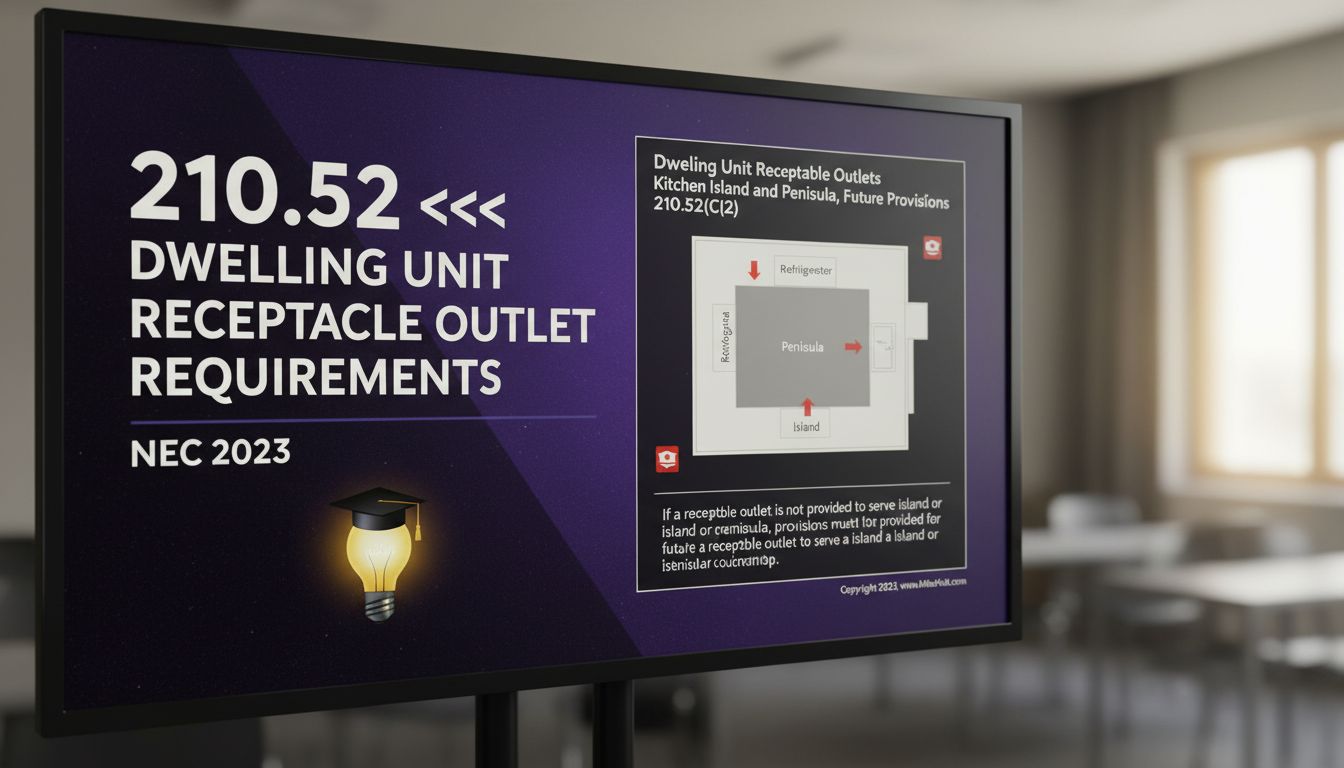
Kitchen counter outlet rules are more stringent than general rooms. Outlets must be placed along every counter run, with no point on any counter surface more than 24 inches from a receptacle. Counters 12 inches wide or less don’t require outlets. Kitchen island and peninsula counters require dedicated receptacles based on the longest horizontal dimension.
All kitchen counter outlets must be GFCI-protected. The small appliance circuits in kitchens require at least two dedicated 20-amp circuits. These circuits are dedicated — they can’t serve anything outside the kitchen counter area. The refrigerator gets its own dedicated 20-amp circuit.
Bathroom and Outdoor Outlet Requirements
Bathrooms require at least one GFCI-protected outlet within 3 feet of each basin. All bathroom outlets must be GFCI-protected regardless of distance from water. Outdoor outlets require weatherproof in-use covers and GFCI protection on dedicated circuits. The NEC requires at least one outdoor outlet at the front and one at the rear of the home.
How Many Outlets Per Room: Practical Counts
Based on the 6-foot rule and typical room dimensions, here are practical outlet counts:
- Standard 10×12 bedroom: 4 to 5 outlets minimum
- 12×15 living room: 6 to 8 outlets minimum
- Standard kitchen: 4 to 6 counter outlets plus dedicated appliance circuits
- Bathroom: 1 to 2 GFCI outlets near each basin
These are minimums. Adding extra outlets beyond code in living rooms, offices, and bedrooms is inexpensive during new construction or renovation framing and significantly more convenient than adding them later after drywall installation.
Next steps: Before any renovation that involves wall opening, verify your current outlet placement against the NEC requirements for each room type. Adding outlets to meet code while the walls are open costs a fraction of adding them after drywall installation. A licensed electrician can walk through the layout in a brief consultation and identify any spacing violations worth addressing while access is easy.