Commercial Drywall: Systems, Contractors, and What Sets It Apart
Commercial drywall is not a scaled-up version of residential work. The codes are stricter, the assemblies more complex, and the finish standards often tighter. If you’re managing a build-out, tenant improvement, or new commercial construction project, understanding what commercial drywall contractors do differently helps you hire the right crew and write a scope that gets you the result you need. This guide covers commercial drywall systems and their requirements, how to work with drywall contractors on a commercial job, what quality drywall actually means in a commercial context, and how to read a bid.
Whether you’re specifying custom drywall for a high-end retail interior or managing a straightforward office build-out, the fundamentals here apply. When the system requirements get complex — fire ratings, sound ratings, structural shear walls — always verify your specifications with a licensed professional.
What Commercial Drywall Actually Involves
Fire-Rated and Structural Drywall Systems
In commercial construction, drywall systems are tested assemblies — not just individual products. A 2-hour fire-rated wall isn’t just Type X gypsum board on studs. It’s a specific combination of stud spacing, board thickness, layer count, fastener schedule, and joint treatment that Underwriters Laboratory (UL) has tested and certified as a complete system. Substituting one component — even a faster fastener pattern — can void the rating.
Commercial drywall contractors working on fire-rated assemblies need to follow the UL design number exactly as specified. Your architect or mechanical engineer should include those UL numbers in the drawings. If they don’t, ask before work starts — not after an inspection fails.
Structural drywall sheathing (used on exterior steel-frame buildings) adds a shear load component to the mix. These panels resist lateral forces and are specified by structural engineers, not interior designers. Installing standard interior panels where structural-rated material was specified is both a code violation and a safety issue.
Acoustic and Custom Drywall Applications
Sound-rated drywall systems in commercial settings include everything from standard STC-rated party walls in multi-tenant offices to recording studio isolation rooms that use decoupled assemblies with resilient channels. The STC rating you need drives the assembly: an STC 45 wall looks very different from an STC 60 wall, and getting custom drywall assemblies wrong in a building where tenant noise complaints are a lease issue is an expensive mistake.
Custom drywall work in commercial projects also covers curved walls, radius corners, coved ceilings, and bulkheads. These require flexible board (1/4-inch), specialty trims, and crew members who have done the geometry before. Not every commercial drywall contractor has this capability — ask for photos of comparable work.
How Commercial Drywall Contractors Work
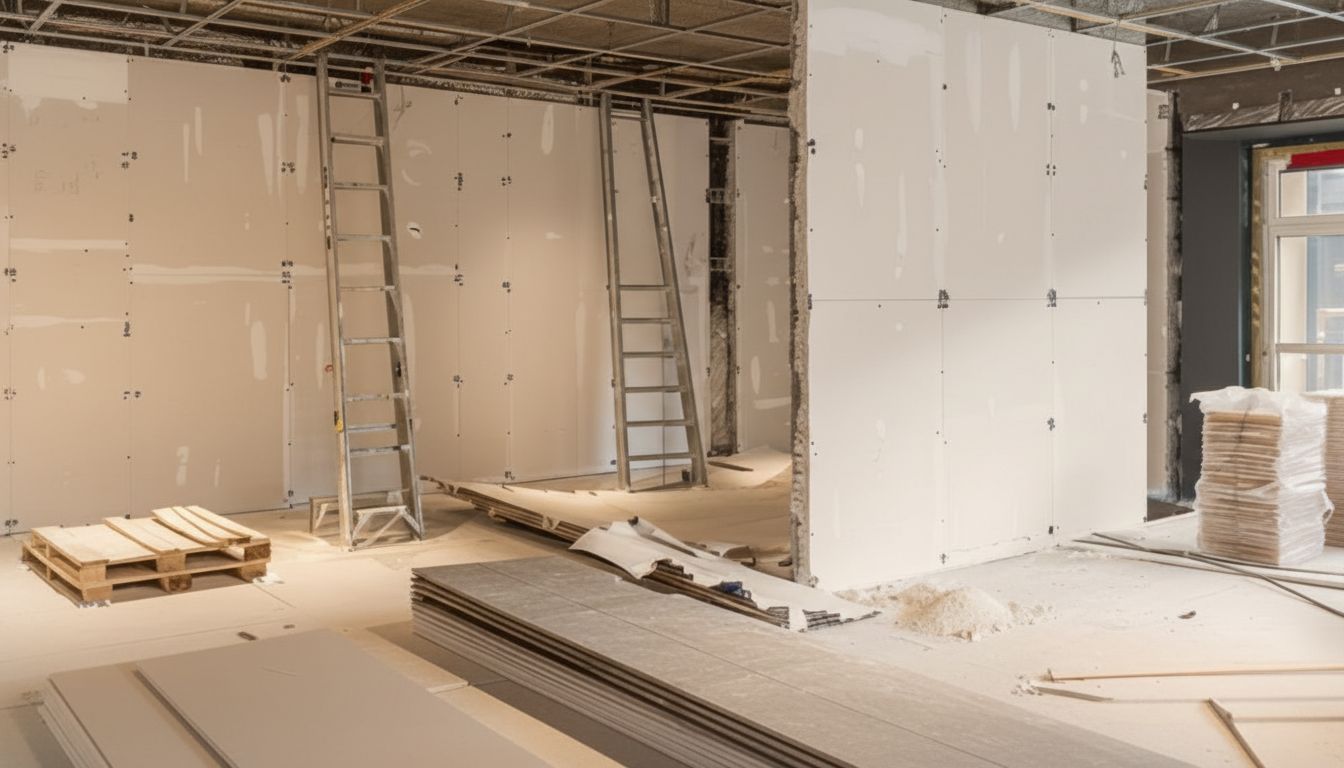
Commercial drywall contractors typically work from a set of architectural drawings that specify stud gauge and spacing, board type and thickness, finish level, and any rated assembly numbers. A good crew reads those drawings and flags discrepancies before breaking ground, not after running into a conflict with the mechanical trades in the ceiling.
Coordination with other trades is a larger part of commercial work than residential. Drywall framing happens before mechanical, electrical, and plumbing rough-in on some walls and after on others. The drywall contractor’s project manager should be in regular coordination meetings with the GC, not just showing up when it’s time to hang.
On larger projects, commercial drywall contractors often separate hanging crews from finishing crews. Hanging is production-rate work — speed matters. Finishing is craft work — consistency and surface quality matter. Crews specialized in each stage usually outperform generalist crews on large commercial jobs.
Specifying Quality Drywall for Commercial Projects
Finish Levels in Commercial Drywall Systems
The Gypsum Association’s finish level system (Level 0 through Level 5) defines exactly what quality drywall means at each stage. For commercial work:
- Level 3: Texture applied over tape and compound — used in utility areas or where heavy texture hides imperfections
- Level 4: Standard for most commercial painted walls — flat paint applied directly over the compound
- Level 5: A skim coat over the entire surface — required for gloss or semi-gloss paint, and for walls under raking or critical lighting
Specify the level in your contract scope. “Paint-ready” means different things to different contractors. Level 4 is paint-ready for eggshell; it’s not paint-ready for gloss without a Level 5 finish. If the lighting plan includes wall washers or accent lighting, Level 5 is not optional.
Choosing Materials for Quality Drywall Results
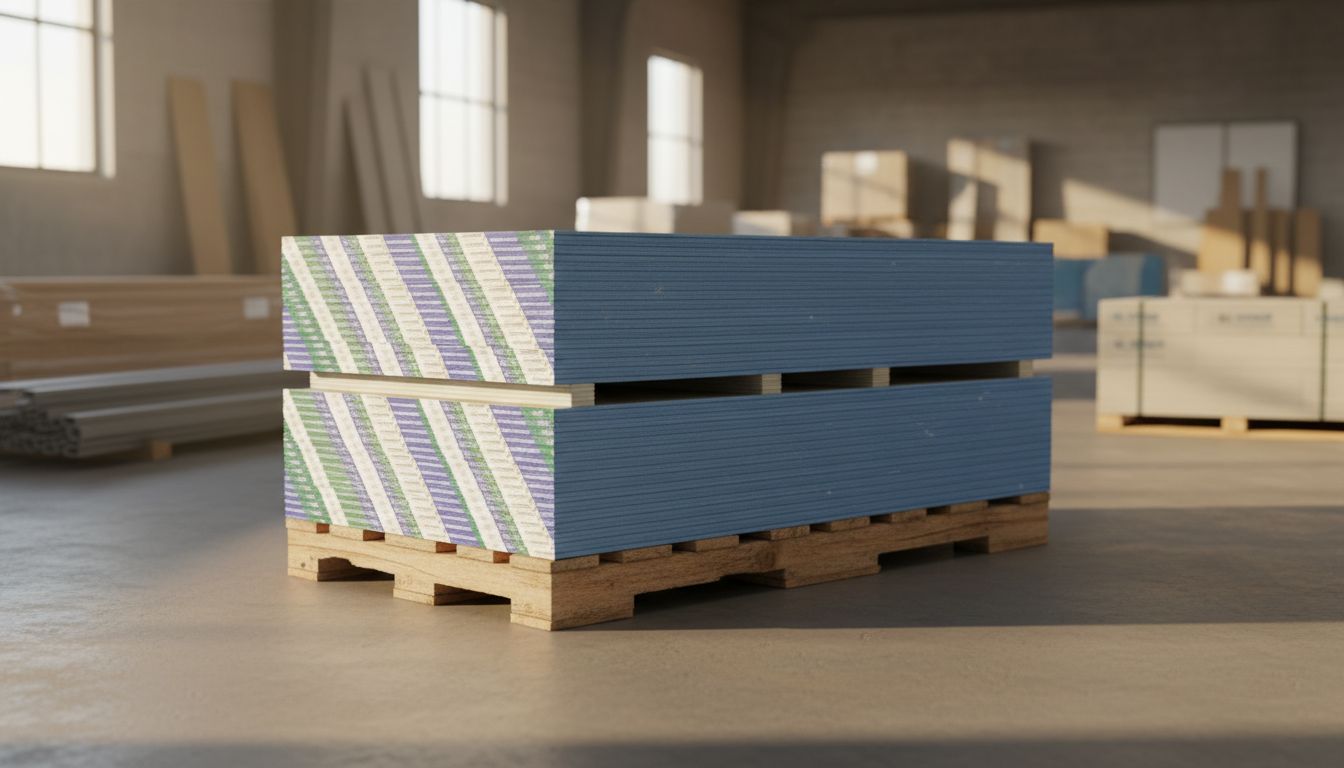
Quality drywall on commercial projects starts with the right board selection. Standard 1/2-inch regular board works for interior partitions in dry, conditioned spaces. Moisture-resistant (green board or purple board) goes in areas prone to humidity — near plumbing chases, in server rooms, in kitchen areas. Glass mat gypsum goes anywhere with direct water exposure risk. Using standard board in a high-humidity area is false economy — it fails quickly and replacement costs far more than the upgrade would have.
Cost Factors in Commercial Drywall Work
Commercial drywall pricing runs per square foot for labor, with materials quoted separately or bundled. Standard hanging and taping in a straightforward commercial office runs $2-$4 per square foot for labor. Add Level 5 finish, specialty assemblies, or difficult access and that number climbs.
Factors that drive cost up:
- High ceilings (above 12 feet) requiring lifts or scaffolding
- Multiple UL-rated assemblies requiring careful documentation
- Phased work where the crew mobilizes multiple times
- Accelerated schedules that require overtime or parallel crews
- Custom drywall shapes, curves, or shadow-gap details
When comparing bids from commercial drywall contractors, confirm every quote includes the same finish level, the same material grade, and the same rated assembly specifications. A bid that comes in 25% lower often means something got dropped from the scope — find out what before signing.