What Is PEX Plumbing: Manifolds, Costs, Problems, and Disadvantages
Understanding what is pex plumbing starts with the material itself: PEX, or cross-linked polyethylene, is a flexible plastic tubing that has largely replaced copper and CPVC in new residential construction over the past two decades. Its flexibility allows it to snake through walls and floors with minimal fittings, it resists freeze damage better than rigid pipe, and it costs significantly less than copper. A pex plumbing manifold system takes this efficiency further by routing individual home-run lines from a central manifold directly to each fixture.
This guide covers how PEX systems work, how to use a pex plumbing cost estimator for budgeting, and the honest pex plumbing problems and pex plumbing disadvantages that every homeowner should understand before committing to a PEX installation.
What Is PEX Plumbing and How Does It Work
PEX tubing is manufactured in three forms — PEX-A, PEX-B, and PEX-C — that differ in their manufacturing process and physical properties. PEX-A (made by the Engel method) is the most flexible, with the best memory for expansion connections and freeze resistance. PEX-B (silane method) is stiffer but the most widely available and cost-effective. PEX-C (radiation crosslinking) falls between the two in flexibility.
PEX connects to fittings using one of three systems: crimp rings, clamp (cinch) rings, or expansion fittings. All three create reliable, watertight connections without soldering. The connections resist corrosion and do not require flux or torch work, making PEX installation accessible to skilled DIYers in addition to licensed plumbers.
PEX is available in three colors: red for hot supply lines, blue for cold, and white or gray for either. Color coding is a visual organizational aid only — all three colors are functionally identical and rated for the same pressures and temperatures.
PEX Plumbing Manifold Systems Explained
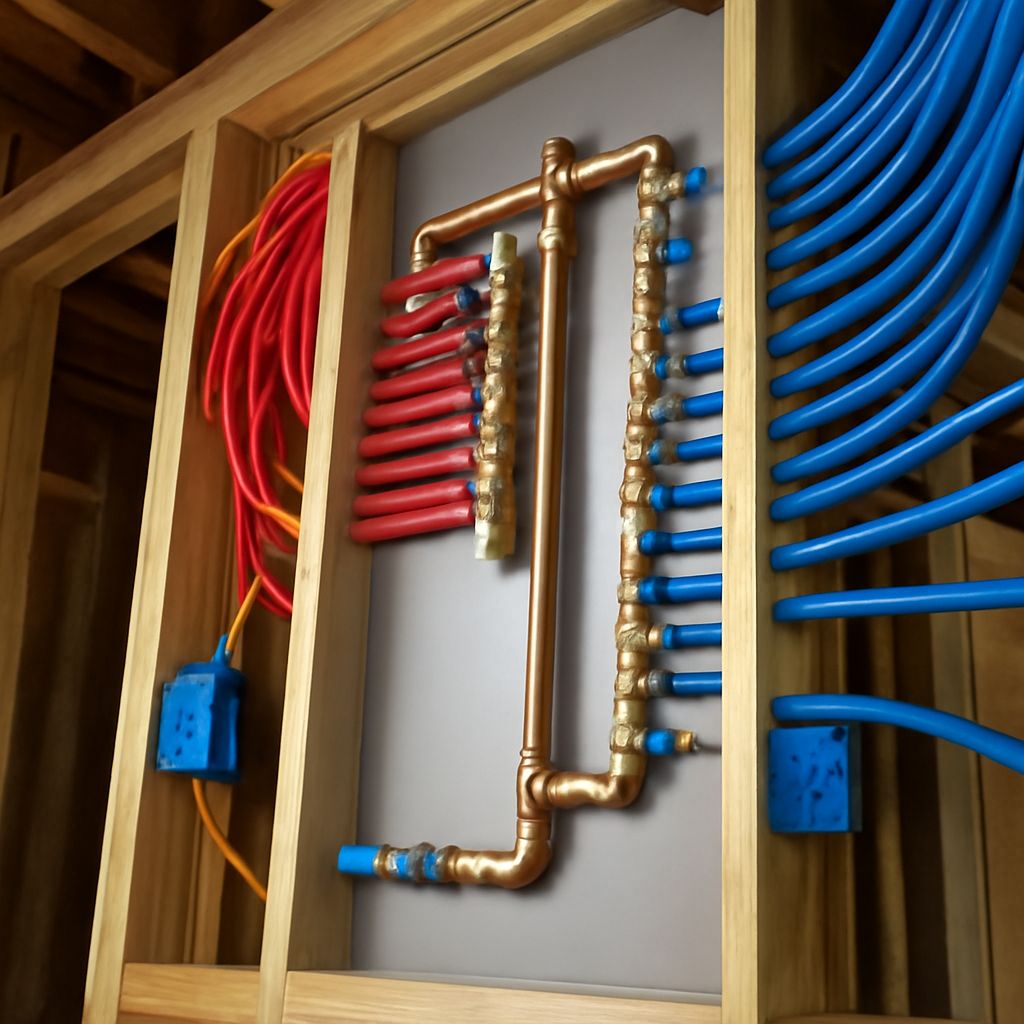
A pex plumbing manifold is a central distribution block — typically mounted in a utility room or mechanical space — with individual supply ports for each fixture or zone in the home. Each port has its own shutoff valve, allowing you to isolate any single fixture (a bathroom sink, a toilet, a kitchen faucet) without shutting off water to the entire home.
Home-run manifold plumbing routes a dedicated PEX line from the manifold to each fixture rather than branching off a trunk line. Advantages include: individual fixture shutoffs without panel access, reduced cross-contamination from fixture-to-fixture flow, and simpler troubleshooting when a fixture develops issues. The tradeoff is higher material cost — more tubing is required for individual runs compared to branched systems — and slightly longer wait times for hot water at fixtures far from the water heater.
PEX Plumbing Cost Estimator: What to Budget
Using a pex plumbing cost estimator for a whole-house repipe: PEX tubing itself costs $0.20 to $0.90 per linear foot depending on diameter and grade. A typical 2,000-square-foot home requires 500 to 1,000 linear feet of supply tubing for a complete repipe. Material cost for tubing alone runs $100 to $900. Add fittings ($200 to $500), a manifold ($100 to $400 for a quality 12-port unit), and connection tools ($100 to $500 for crimp or expansion tools if doing it yourself).
Professional installation cost for a full PEX repipe runs $4,000 to $15,000 depending on home size, access difficulty, and local labor rates. Compare this to copper repiping at $8,000 to $20,000 for the same home and the cost advantage of PEX becomes clear. For partial repairs or adding new circuits (such as an outdoor faucet or laundry stub-out), PEX materials run $50 to $200 and a plumber charges $150 to $400 for a simple addition.
PEX Plumbing Problems and Disadvantages
Honest discussion of pex plumbing problems is important for informed decisions. Known issues include:
- UV sensitivity: PEX degrades when exposed to direct sunlight. It cannot be used for exposed outdoor runs without UV-protective sheathing. This limits its use to interior or buried applications.
- Rodent damage: Rats and mice chew PEX tubing, a problem not seen with copper. In areas with rodent activity, copper or steel-protected PEX is preferred for exposed runs in crawl spaces and basements.
- Chemical leaching concern: Some early studies suggested trace chemical leaching from certain PEX formulations in water. Major certifications (NSF 61) address this, but some homeowners in water-quality-sensitive regions prefer copper for drinking water supply lines.
- Not rated for outdoor use: Most PEX products are not rated for direct burial without conduit, and none are rated for exposed above-grade outdoor installations in direct sun.
Pex plumbing disadvantages compared to copper also include lower temperature ratings (PEX is limited to around 200°F, while copper handles higher temperatures — important near water heaters and boiler connections), and the fact that PEX cannot be used for gas supply lines.
Pro tips recap: Choose PEX-A for maximum flexibility in tight spaces and freeze-prone areas. Always use a manifold system in new construction — the per-fixture shutoff capability pays dividends during any future fixture replacement or repair. Protect PEX from rodent access in crawl spaces with hardware cloth or transition to copper in those areas. And for the water heater connection, use the last 18 inches of copper or CPVC before transitioning to PEX to stay within temperature rating limits.