GFCI Circuit Breaker: Types, Uses, and How to Choose the Right One
A GFCI circuit breaker protects an entire circuit from ground faults, rather than just a single outlet. If you’re weighing a circuit breaker GFCI option against individual GFCI outlets, the choice comes down to how many points of protection you need and what your electrical panel supports. This guide covers how GFCI breakers work, how they differ from standard breakers and GFCI receptacles, and what the older circuit breaker types in many panels tell you about your system’s safety.
You’ll find a direct comparison of gfci circuit breaker vs gfci receptacle performance, guidance on where an air circuit breaker differs from standard residential equipment, and practical advice on what to do if you have an old circuit breaker in a panel that’s aging past its service life.
How a GFCI Circuit Breaker Works
The Ground Fault Detection Mechanism
A ground fault occurs when current finds an unintended path to ground, often through a person. The GFCI function detects imbalances between outgoing and returning current as small as 4 to 6 milliamps and trips within milliseconds, fast enough to prevent electrocution in most cases. A standard circuit breaker GFCI unit handles both functions in one device: it trips on overloads and short circuits just like a conventional breaker, and it also trips on ground faults that would never trigger a regular breaker.
This dual protection makes a circuit breaker with built-in GFCI protection especially useful in bathrooms, kitchens, garages, outdoors, and unfinished basements, which are the same locations the NEC (National Electrical Code) requires GFCI protection for new construction.
Single-Pole vs. Double-Pole GFCI Breakers
Single-pole GFCI breakers protect 120V circuits, which cover most standard household circuits. Double-pole GFCI breakers protect 240V circuits like hot tubs, large HVAC equipment, and EV chargers. If you’re adding GFCI protection to a 240V circuit, a double-pole circuit breaker GFCI is your only option at the panel level, since standard GFCI outlets are 120V only.
GFCI Circuit Breaker vs. GFCI Receptacle
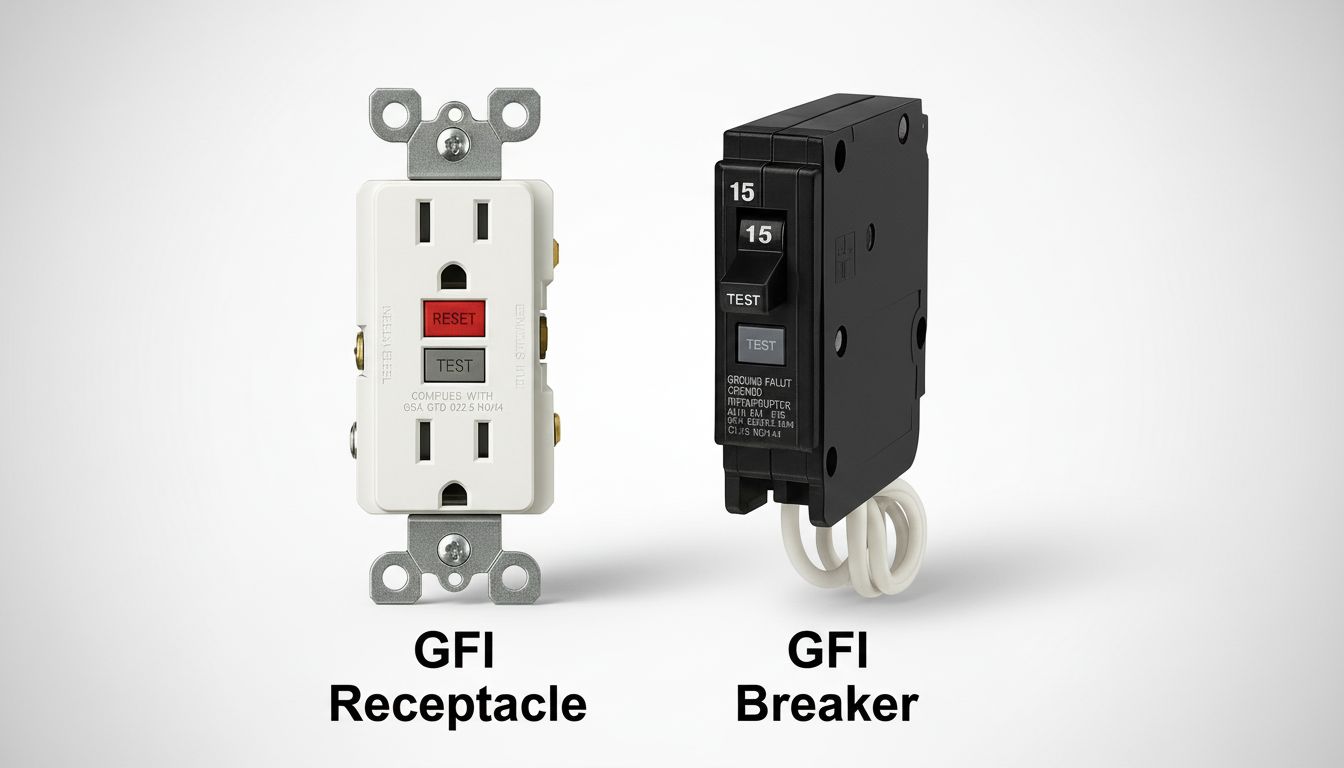
The gfci circuit breaker vs gfci receptacle decision comes down to scope and cost. A GFCI receptacle protects only the outlet itself and any downstream outlets connected to it. A GFCI breaker at the panel protects every outlet, light, and device on the entire circuit. For a bathroom with four outlets on one circuit, a single GFCI breaker is cheaper than four GFCI receptacles and provides complete circuit protection.
The downside of the panel-level approach is that a ground fault anywhere on the circuit kills power to everything on that circuit. With a GFCI receptacle, only devices plugged into that outlet lose power. In a kitchen where you want some outlets to remain active during a fault, individual receptacles give you more control.
Cost comparison: GFCI receptacles run $15 to $25 each. A GFCI circuit breaker typically costs $30 to $60 depending on brand and amperage. If you have a long circuit with many outlets, the breaker is often the more economical total solution.
Air Circuit Breaker: What It Is and Where It’s Used
An air circuit breaker uses air as the arc-extinguishing medium when the contacts open under load. These are industrial and commercial devices, not standard residential equipment. If you encounter the term in a residential context, it’s typically being used loosely to describe a standard molded-case breaker. True air circuit breakers appear in industrial switchgear and large commercial panels where fault currents and system voltages are far higher than residential levels. If your home panel needs replacement, a licensed electrician will specify the correct residential breaker type.
When Your Old Circuit Breaker Becomes a Safety Issue
An old circuit breaker in a panel from the 1970s or earlier is worth a close look. Standard residential breakers are rated for 30 to 40 years of service, but age alone isn’t the only factor. Certain older panel brands, including Federal Pacific Electric with Stab-Lok breakers and Zinsco panels, have documented failure rates that have led most electrical inspectors and insurance underwriters to flag them as safety hazards. These old circuit breaker designs may fail to trip on overloads or may arc internally.
If you have an older panel with these brands, a licensed electrician can evaluate whether replacement is warranted. Don’t attempt to replace breakers in these panels yourself, since compatibility issues and the condition of the bus bar can create new hazards.
Next steps: If you’re adding GFCI protection to an existing circuit, start by checking whether your panel supports the breaker brand you need. Most GFCI breakers are brand-specific and won’t fit competitor panels safely. For new construction or full panel upgrades, plan GFCI protection into the design from the start. Test your GFCI breakers monthly by pressing the test button and confirming the circuit loses power, then reset it to restore service.