1/4 Inch Drywall: Uses, Installation, and When Quarter Inch Drywall Makes Sense
1/4 inch drywall is a specialty product that most homeowners never encounter in standard renovation work. It has specific applications where its thin profile and flexibility provide advantages that standard 1/2-inch panels cannot match. Whether you’re researching 1/4 drywall for curved walls, looking at 1/4″ drywall for overlaying an existing surface, or trying to figure out if 1/4 in drywall is appropriate for your basement finishing project, this guide explains where this product works and where it does not. Quarter inch drywall is not a cost-saving substitute for standard panels. It has a narrow set of appropriate uses and real limitations outside of them.
The flexibility of 1/4-inch drywall makes it the only gypsum board option for curved walls, arched ceilings, and tight-radius surfaces that would crack standard panels. That is its primary purpose in modern construction.
What 1/4 Inch Drywall Is Used For
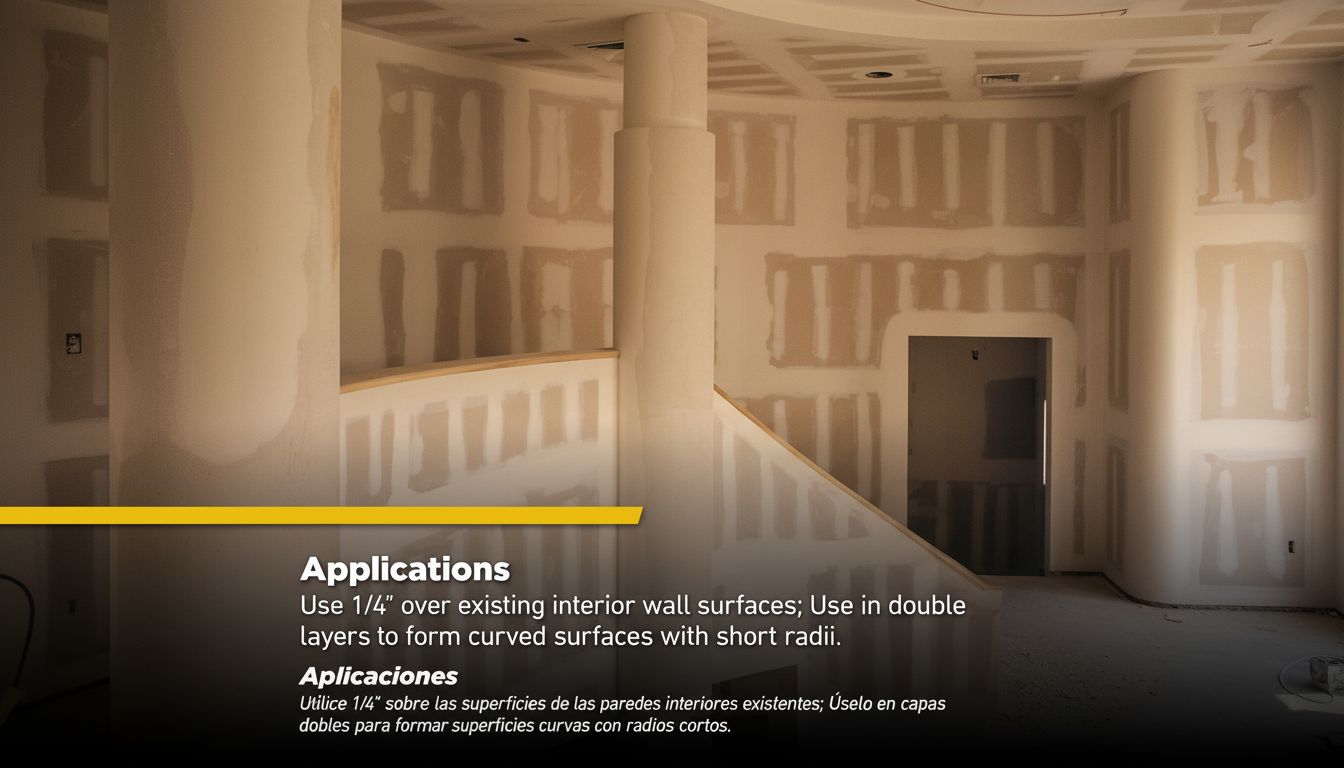
Curved walls and barrel ceilings are the most common application for 1/4 in drywall. When a wall curves in plan or a ceiling arcs in profile, standard half-inch panels crack rather than flex. Quarter-inch panels can be dry-bent to radii as small as 5 feet for a single layer, or even tighter using a double-layer wet application. Double-layering 1/4″ drywall over an inner layer gives you full 1/2-inch total thickness on a curved surface with smooth finish potential.
Overlaying existing drywall is another application for 1/4 drywall. When existing walls are wavy, damaged, or heavily textured and you want a new surface without full removal, installing a 1/4-inch layer over the existing surface adds minimal depth while creating a fresh substrate for painting or wallpaper. This approach is faster and less disruptive than stripping and replacing full panels but adds about 1/4 inch to every wall, which affects trim, outlet boxes, and door and window jamb depths.
Where 1/4 Inch Drywall Does Not Work
Quarter inch drywall should not be used as the primary layer on standard flat walls or ceilings. It lacks the rigidity to span between studs without flexing, and the resulting surface will feel soft and give under pressure. Any impact will dent or crack it more readily than standard panels. Fastener pullout strength is significantly lower than half-inch panels, so hanging anything on a wall covered only with 1/4″ drywall requires hitting studs rather than relying on the panel for any load.
1/4 inch drywall is also not a fire-rated product. Wherever code requires Type X or fire-rated gypsum board, 1/4-inch panels are not an acceptable substitution regardless of how many layers you apply. For any application requiring fire separation, use the specified 5/8-inch Type X product.
Installing Quarter Inch Drywall
For curved surfaces, you can dry-bend 1/4-inch drywall by securing one end to framing and gradually bending the panel to the curve. Tighter radii require wetting one face of the panel with a spray bottle and allowing it to flex further before bending. Do not soak the panel; dampening the paper facing on one side is enough to increase flexibility. Allow wet-bent panels to dry fully before taping and finishing. Wet compound applied to incompletely dried panels may cause bubbling or adhesion failure.
For overlay applications, fasten 1/4″ drywall through the existing surface into studs with longer drywall screws. The original panels are not structural fastening points. Adjust electrical box depths and jamb extensions to account for the added thickness before finishing. Tape seams in the 1/4-inch overlay using standard paper tape and joint compound, following the same finish levels as you would for standard panels.
Bottom Line
Quarter inch drywall is a specialized product suited to curved surfaces, overlays, and repair applications. It is not a substitute for standard half-inch panels on flat walls and ceilings. Use it for the applications it was designed for, verify that your project does not require fire-rated construction before specifying it, and plan for the trim and box depth adjustments required when using it as an overlay. For any project where the application is unclear, consult a licensed drywall contractor before purchasing material.